
Founders love to say they’re “not ready” for automation.
Too early.
Too expensive.
Too complex.
We’ll do it after the raise.
After traction.
After the next hire.
That belief quietly kills more ventures than bad ideas ever do.
Here’s the truth most people avoid:
If your venture cannot run without constant human memory, effort, and enforcement, it is not scalable.
It is fragile.
Automation is not about efficiency.
It is about survivability under pressure.
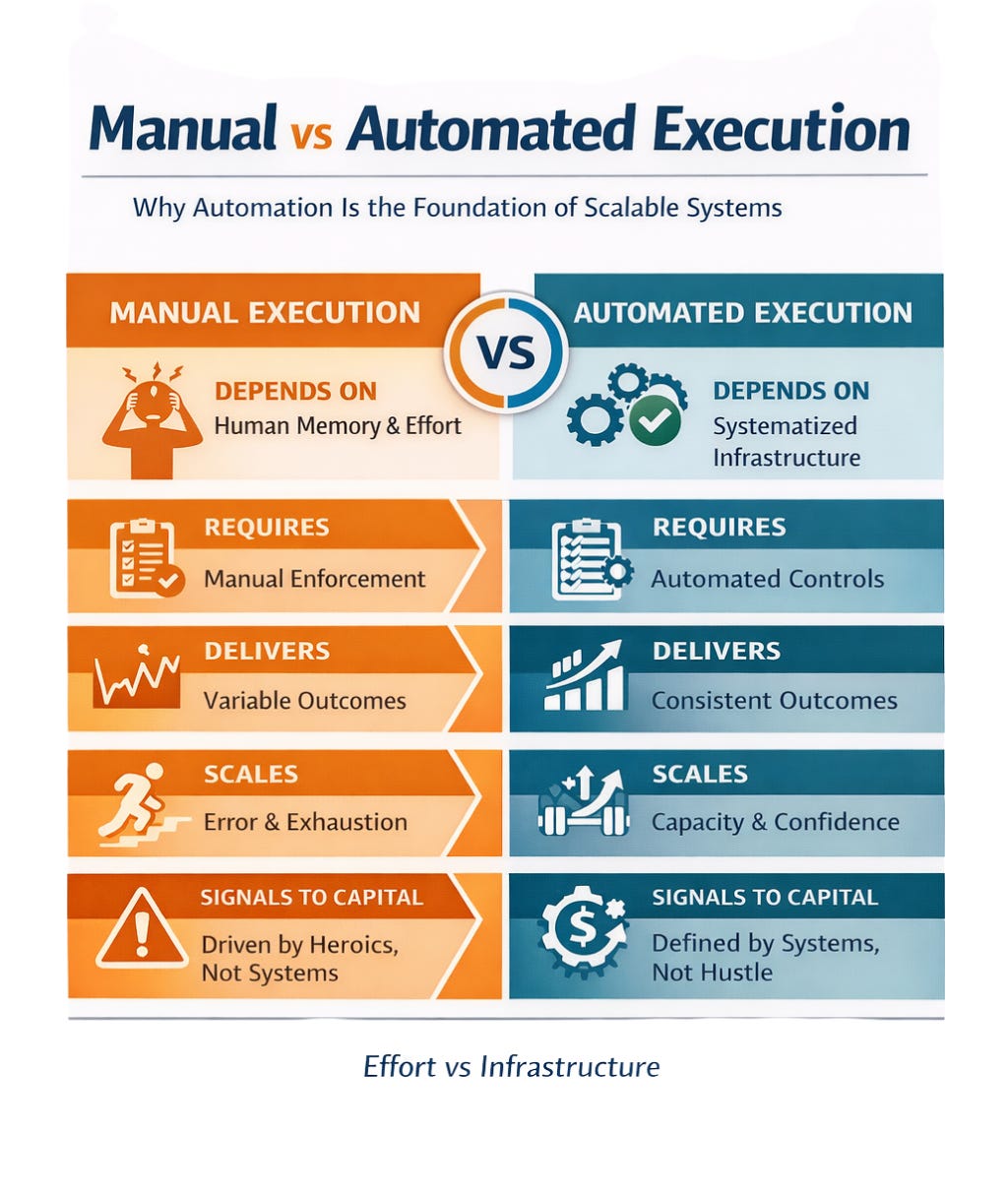
Manual execution doesn’t scale. It fractures.
This visual shows the real difference between:
Effort vs infrastructure
Founder-dependence vs system stability
Growth that exhausts vs growth that strengthens
👉 Download the “Manual vs Automated Execution” one-page visual
The Lie Founders Tell Themselves
“We’ll automate later.”
What they mean is:
I’m holding the system together manually.
I’m afraid to expose where the process breaks.
I think hustle can substitute for infrastructure.
It can’t.
Manual execution doesn’t prove commitment.
It proves that capacity is trapped inside people instead of systems.
And people don’t scale.
Why Manual Execution Is the Real Bottleneck
Every venture hits the same invisible ceiling:
Follow-ups missed
Intake handled inconsistently
Delivery quality varies by who’s tired
Reporting becomes guesswork
Accountability dissolves
Founders become the system
This isn’t a funding problem.
It’s an architecture problem.
When execution lives in humans:
Scale increases error
Growth increases risk
Complexity accelerates collapse
Manual processes don’t bend — they snap.
Automation Is Capacity, Not Convenience
Automation is not about speed.
It’s about consistency without supervision.
Properly designed automation:
Removes decision fatigue
Enforces standards
Preserves institutional memory
Reduces founder load
Stabilizes delivery under stress
Automation doesn’t replace people.
It protects them.
Especially founders.
What Actually Breaks Without Automation
When ventures avoid automation, five things fail first:
Delivery
Outcomes depend on who remembered what.Follow-Through
Promises decay between inboxes and good intentions.Measurement
Data becomes anecdotal, not operational.Governance
Controls rely on trust instead of structure.Founder Longevity
Burnout becomes inevitable, not accidental.
This is why investors read operational fragility long before they read decks.
The Capital Signal Nobody Names
Capital doesn’t ask:
“Do you use automation?”
It asks:
Can this model operate without heroic effort?
Does execution improve or degrade with volume?
Are controls embedded or enforced manually?
What happens if the founder steps back?
Automation answers these questions silently.
Lack of automation answers them loudly.
What Automation Actually Means (No Tools, No Hype)
At minimum, automation should exist across five functions:
Intake — standardized entry, not bespoke onboarding
Delivery — repeatable execution, not artisanal service
Follow-Up — enforced sequences, not memory
Measurement — automatic capture, not retroactive reporting
Escalation — clear triggers, not emotional firefighting
If any of these depend on you remembering, chasing, or improvising —
you don’t have infrastructure.
You have effort.
The Line That Matters
If your venture only works when you’re “on,”
it doesn’t work.
Automation is not optional for scale.
It is the condition that makes scale survivable.
The Hard Question
What still requires you to remember, chase, or manually enforce — and what would break if you stopped?
Sit with that.
If this post exposed where execution still depends on you, the problem isn’t effort. It’s infrastructure.
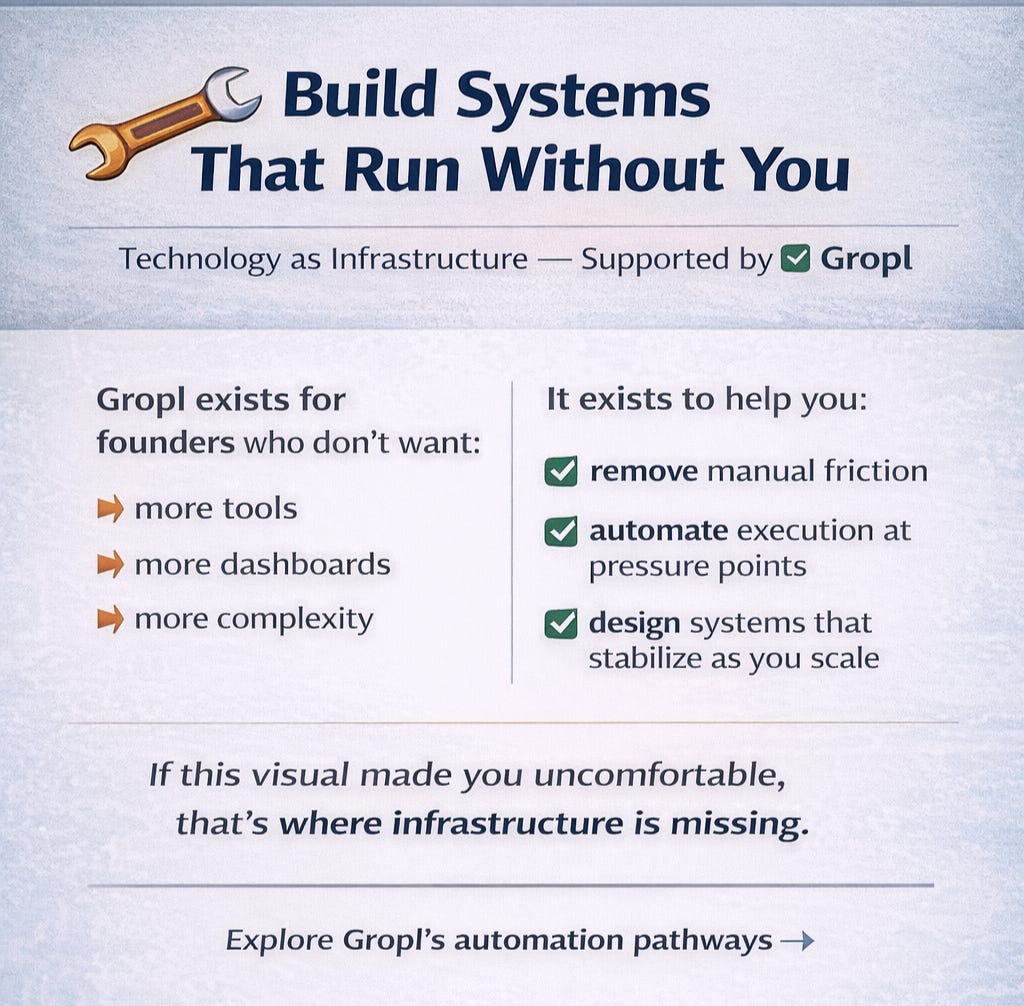
👉 Explore Gropl’s automation pathways → https://gropl.io
(For founders ready to replace effort with systems)
Technology as Infrastructure is supported by Gropl.io — because execution systems, not inspiration, determine whether impact survives scale.